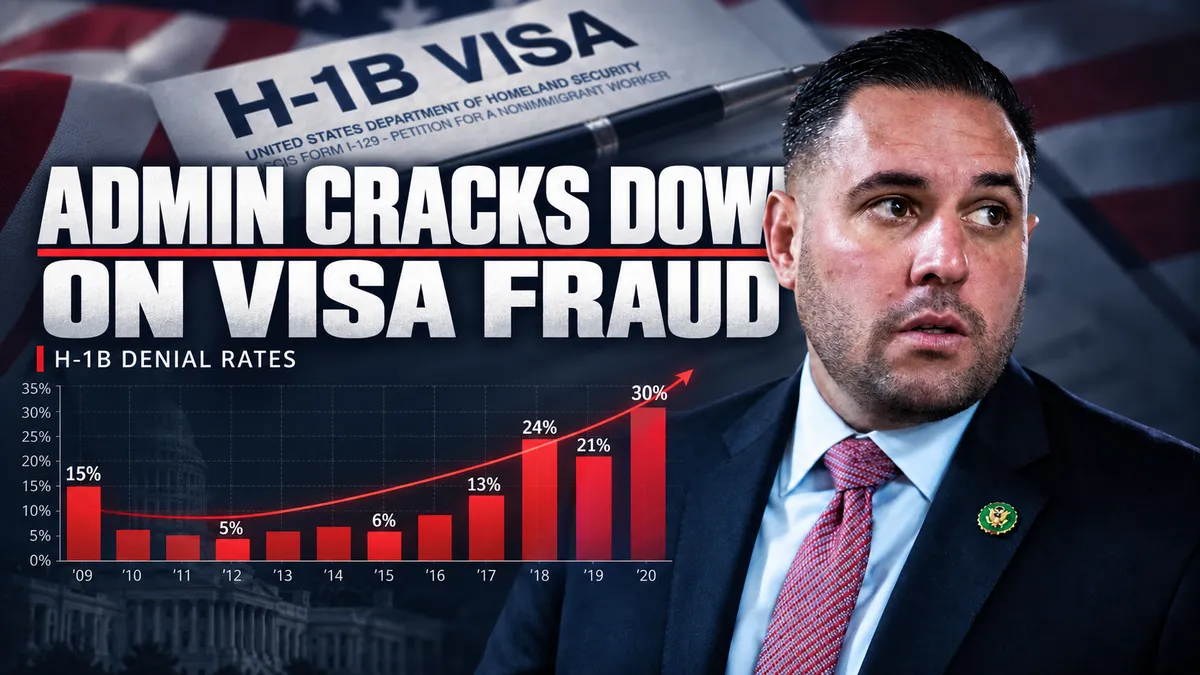
The Trump Administration is Cracking Down on H-1B Fraud. L-1 Visa Fraud is Worse.
By Puneet Ahluwalia
The Trump administration has sent an unmistakable message that a visa to visit, work, or study in the United States is a privilege, not a right. And more, that those who hold a visa obtained through fraud can expect to lose it, and even face criminal prosecution.
The State Department has revoked more than 175,000 visas since President Trump returned to office. Moreover, they are reportedly getting ready to revoke as many as 200,000 more that involve visas issued to those who initially claimed to be visiting short term, but have since filed for permanent residence.
Equally important, Labor Department Inspector General Anthony D’Esposito has launched a major criminal investigation into fraud, human trafficking and worker exploitation within the H-1B visa system.
That crackdown is overdue.
But it seems to fall short because public comments suggest it ignores the L-1 visa program, a category with fewer safeguards, greater opportunities for abuse and potentially more damaging consequences for American workers.
H-1B has serious problems, but at least Congress built guardrails around it to prevent the most blatant fraud and abuse. For example, most H-1B visas are subject to annual caps, prevailing wage requirements, and specific labor conditions. Applicants must qualify for specialty occupations, and demand is so high that many petitions are subjected to a lottery.
The L-1 program has virtually none of those protections.
There is no annual limit. There is no comparable prevailing-wage requirement. There is no meaningful test to determine whether a qualified American could fill the job. “Specialized knowledge” can be defined so that almost any familiarity with a company’s products or systems becomes enough to justify a foreign worker over an American.
Even more troubling, the L-1A category supposedly reserved for genuine executives and managers can provide a fast track to permanent residence through the EB-1C category without the labor-certification process required in other employment-based visa cases.
The loophole is huge and ripe for abuse.
Why should an employer accept a numerical cap, a lottery, or wage obligations when it can label an employee a “manager,” transfer that person through an uncapped program and potentially place him on a shorter path to a green card?
That is precisely why the allegations involving Tata Consultancy Services demand federal investigation. Three former employees alleged that TCS manipulated the L-1A program by presenting technical, consulting and sales personnel as managers. Bloomberg reported that TCS obtained more than 6,500 L-1A approvals between 2019 and 2023; more than the next seven largest recipients combined.
One whistleblower claimed that he was instructed to alter organizational charts to make TCS appear to employ more managers. Another said his application described him as a manager even though he had no subordinates and actually worked in sales. He reportedly earned half what comparable American employees received.
TCS denies wrongdoing, but when multiple former employees describe allegedly fabricated managerial roles and organizational charts, investigators should take note … and issue subpoenas.
Federal authorities reportedly have already identified approximately 1,800 instances of suspected L-visa fraud, including nearly 200 cases in which L-1A recipients were found not to be managers. The truth is that the L-1 visa system is more vulnerable to fraud than the H-1B system, so why isn’t it receiving the same scrutiny?
It’s not just a problem with multinational corporations either. Small companies can acquire a post box in another country; then claim someone living there is an executive, manager or indispensable employee eligible for transfer to the United States. It’s a fast and cheap way to get a girlfriend, relative, or drinking buddy to the U.S. Or worse, a cheap foreign worker who replaces an American employee.
Just because the paperwork shows a foreign office doesn’t make for a genuine international business.
Inspector General D’Esposito has correctly said visa abuse is not merely paperwork fraud. It can mean vulnerable foreign workers trapped by their employers, Americans displaced by cheaper labor and criminals enriching themselves by bilking government programs meant to help those in real need.
Every one of those dangers exists in the L-1 system. Yet the L-1 program lacks even the limited wage and labor protections applicable to H-1B employers.
Because the Labor Department does not administer the L-1 program in the same way it oversees H-1B labor requirements, D’Esposito should immediately bring the Department of Homeland Security, State Department, Justice Department and the administration’s fraud task force into a coordinated investigation.
They should examine sham affiliates, false managerial titles, fabricated organizational charts, wage disparities, retaliation against whistleblowers and differences between the jobs described in visa petitions and the work employees actually perform.
There are good reasons legitimate companies may want to transfer genuine executives. But the L-1 visa cannot remain an open pipeline for cheap labor or an unaccountable shortcut to permanent residence.
D’Esposito has promised to expose fraud, protect American workers and put criminals in cuffs. If he confines his investigation to H-1B only, he’ll miss the L-1 loophole that’s costing Americans thousands of jobs, but no one seems willing to talk about.
