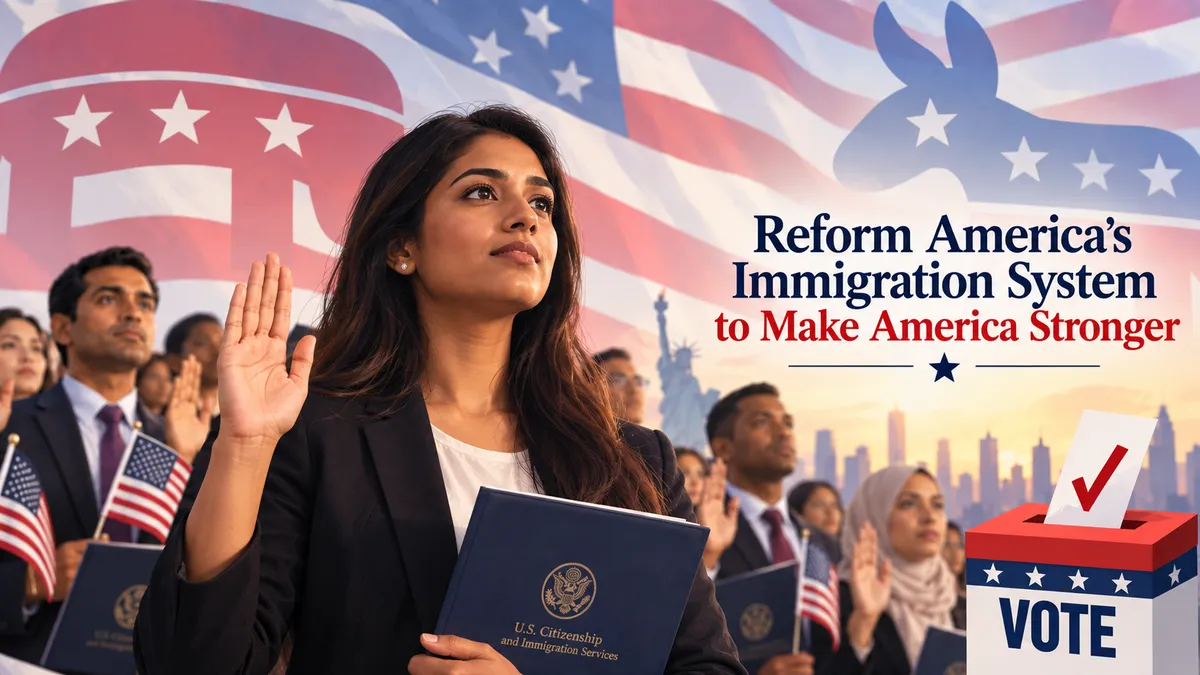
A Million New Indians Doesn't Mean A Million New Democrats
By Puneet Ahluwalia
There is an assumption about immigration made strange by the fact that many on the left and right absolutely agree. The assumption is that more immigrants mean more Democrats.
It’s why the left views immigration as a political advantage, even throwing open the gates to whoever cares to come.
Many on the right agree a new immigrant is an undoubted future Democrat, and it scares them.
Those hopes and fears increasingly shadow the debate over America’s work visa systems — H-1B and L-1 visas.
The arithmetic sounds simple. Immigrants historically identify more often as Democrats, so more immigrants mean more Democrats. But such thinking ignores the reality that immigrants aren’t motivated to cross oceans in order to join political parties.
They come searching for something here they can’t find anywhere else.
Consider the engineer in Hyderabad who spends years trying to obtain permission to work permanently in America. Or the physician in Mumbai who moves his wife and children halfway around the world. Or the young software developer who leaves parents, friends, language and everything familiar behind.
Why?
Usually, because he believes that in America freedom matters. That who you can become isn’t constrained by where you were born, or who your parents are, or what your tribe tells you. And that your children can go further than you.
In other words, he is choosing America.
Choosing America where freedom of speech belongs to the person criticizing the president as much as the person praising him.
Where liberty protects the Hindu temple, Christian church and Muslim mosque just as much as the man or woman who chooses none of them.
Where governors are subject to the same laws as those they govern. Where political opponents are not enemies of the state. Where caste or class is pre-determined or locked in.
Where your family, your birth, or the melanin level in your skin don’t determine your future; but hard work, sacrifice, skill, and innovation do.
It’s true of course that America has often failed to live up to its aspirations perfectly. But those are the ideals we strive to achieve. Most nations don’t even claim such ideals, and when they do they fail far more spectacularly to meet them than does the U.S. Ironically the leaders of those countries are frequently the ones most often to criticize our’s.
All the more reason the debate over immigration should start with a consideration of whether the people we welcome want to embrace America’s aspirations.
For too long, we’ve confused assimilation with cultural erasure. But assimilation isn't about surrendering your heritage, it’s about acquiring a new one. An American heritage, unique in the history of the world.
That should be the objective of a successful immigration system: not simply importing new laborers, but welcoming new Americans.
None of this means new immigrants are automatic Republicans waiting only to hear the inspired speeches of Abraham Lincoln and Ronald Reagan to discover political truth.
History tells us that with rare exception, most recent immigrants — along with their children and grand children — lean more toward the Democratic Party. But we know the past doesn’t dictate destiny.
Polls conducted over several years by the Pew Research Center make the point. Their 2022 survey found that 68 percent of Indian-American identified as Democrats at that time. But by 2026, that number had fallen to 46 percent.
Interestingly, the movement away from Democrats didn’t all accrue to the benefit of Republicans, it mostly moved toward independence. According to Pew, 29 percent of Indian-Americans now identify as independents.
Ideologically, the largest group are moderates at 32 percent.
That doesn’t mean there’s a Republican revolution in the works, but it does show evidence of political fluidity. And it indicates party attachment based on ethnicity, religion, or skin color isn’t guaranteed.
The 2024 presidential election proved it dramatically. Donald Trump increased his support among Indian Americans by 10 points between 2020 and 2024 — from 70/20 to 60/30. Young men especially moved toward Trump.
Despite their more recent dissatisfaction with Donald Trump, polling earlier this year shows the movement toward independence is continuing.Democratic identification remains well below its 2020 level.
Consider what Indian Americans say they most cared about; and it’s not security concerns in India or U.S. - India relations.
It’s inflation. It’s jobs and the economy. Health care. Immigration. Education.
They care about the cost of groceries. About good jobs. About the safety of their neighborhoods. About the futures of their children.
It all sounds a lot less like an immigrant voting bloc, and more like the American electorate.
The debate over employment-based immigration systems like the H-1B and L-1 visas is worthwhile. If they’re deemed useful, then sturdy guardrails should be erected to prevent abuse.
Such rules would prohibit companies from manipulating H-1B or L-1 programs to replace qualified Americans with cheaper foreign labor. They would require employers to pay appropriate wages. And they would be structured to assure work-visa systems met genuine needs in the American economy rather than becoming vehicles for labor arbitrage.
America has every right to determine how many immigrants it admits and which immigrants best serve its national interest.
But rather than worry about partisan concerns, we should be asking a more pertinent question. Who do we want to become Americans?
Sure, we want people who add value to our economy and our society. People prepared to work, build companies, cure diseases, and create prosperity.
But just as important, we should want people committed to the American experiment. People prepared to respect the rights of their neighbors even if they vote differently, worship differently, and speak differently.
People who believe in the dignity and value of every person, who believe daughters deserve the same consideration as sons, who accept equality before the law.
People who understand that American citizenship confers enormous rights, but just as important, requires a strong commitment to personal responsibility, hard work, and high character.
If we achieve that, then the political question largely disappears. Republicans can make their case. Democrats can make theirs. Neither party gets an entitlement to those votes.
